Making Time in Stanley Kubrick's Barry Lyndon: Art, History, and Empire by Maria Pramaggiore
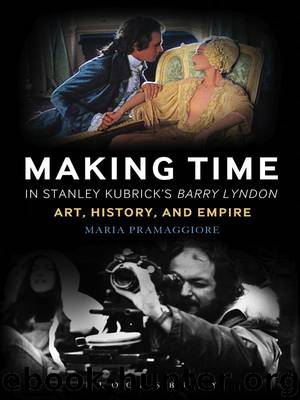
Author:Maria Pramaggiore
Language: eng
Format: mobi, epub
ISBN: 9781441125545
Publisher: Bloomsbury Publishing
Published: 2014-12-17T22:00:00+00:00
Sequencing reality
One of the remarkable aspects of the contemporary critical response to Barry Lyndon is the way that Kubrick’s attention to detail, evidenced in his research for the Napoleon project, and his interest in experimenting with new film technologies such as front projection in 2001 contributed to a discourse of historical authenticity around Barry Lyndon. There are numerous examples of this perspective, from TIME magazine critics Martha Duffy and Richard Schickel, whose comment that the film seemed to be “a documentary of the eighteenth century manners and morals” (163) was cited earlier, to Ken Adam in his interview with Michel Ciment, to Irish Times blogger Donald Clarke, who wrote in 2013 that “the picture really seems to laze along at the pace of eighteenth century society” (“50 years, 50 films”). Any understanding of Barry Lyndon as documentary, or as a straightforward costume drama or historical epic must be questioned in light of what is clearly an artful and artificial first person narration in Thackeray’s memoir and in the context of Kubrick’s own work.
In all of his films, and particularly in those that immediately precede Barry Lyndon—Dr. Strangelove, Lolita, 2001, and A Clockwork Orange—Kubrick laid claim to a narrative and visual style blending realism and surrealism rather than hewing to a representational ethos of Hollywood continuity and narrative transparency. Kubrick’s heightened interest in the aesthetic environment of Barry Lyndon, which translated into copious preproduction research on eighteenth-century British and European painting, and what might be called the technology fetishism of the much ballyhooed extremely fast 0.7f Zeiss lens (which, in 2014, remains the fastest lens ever used in film production) should, instead, be understood as contributing to Kubrick’s exploration of the uncanny, not as part of a realist–historical project. As James Naremore notes, “much like Franz Kafka, [Kubrick’s] most bizarre effects emerge from the very clarity with which his imagery is rendered” (40). In a 1971 interview with Penelope Houston, Kubrick voiced his own thoughts on this subject in this manner: “I have always enjoyed dealing with a slightly surrealistic situation and presenting it in a realistic manner” (Houston 114).
Thackeray and Kubrick’s rejection of historical realism is also a realization that history is an aesthetic endeavor; primarily, but not exclusively, a narrative one. This focus unmasks both the experience of temporality and the concept of history as by-products of aesthetic form rather than as “raw materials.” The aesthetic forms of interest to Kubrick not only assume the shape of narrative sequencing, the subject of this chapter, but also the visual conventions of painting, photography, and cinema, which are subjects addressed in Chapter 5. In the next several chapters, my analysis departs from an examination of narrative form to address the visual and spatial implications of Kubrick’s temporal experiments. Chapter 4 looks at the notion of the cycle as counterpoint to sequence, while Chapter 5 interrogates the concept of stasis and slowness in the film in relation to painting and cinematography.
Download
Making Time in Stanley Kubrick's Barry Lyndon: Art, History, and Empire by Maria Pramaggiore.epub
This site does not store any files on its server. We only index and link to content provided by other sites. Please contact the content providers to delete copyright contents if any and email us, we'll remove relevant links or contents immediately.
| Coloring Books for Grown-Ups | Humor |
| Movies | Performing Arts |
| Pop Culture | Puzzles & Games |
| Radio | Sheet Music & Scores |
| Television | Trivia & Fun Facts |
The Kite Runner by Khaled Hosseini(5178)
Gerald's Game by Stephen King(4654)
Dialogue by Robert McKee(4400)
The Perils of Being Moderately Famous by Soha Ali Khan(4219)
The 101 Dalmatians by Dodie Smith(3511)
Story: Substance, Structure, Style and the Principles of Screenwriting by Robert McKee(3468)
The Pixar Touch by David A. Price(3437)
Confessions of a Video Vixen by Karrine Steffans(3308)
How Music Works by David Byrne(3268)
Harry Potter 4 - Harry Potter and The Goblet of Fire by J.K.Rowling(3073)
Fantastic Beasts: The Crimes of Grindelwald by J. K. Rowling(3058)
Slugfest by Reed Tucker(3002)
The Mental Game of Writing: How to Overcome Obstacles, Stay Creative and Productive, and Free Your Mind for Success by James Scott Bell(2908)
4 - Harry Potter and the Goblet of Fire by J.K. Rowling(2702)
Screenplay: The Foundations of Screenwriting by Syd Field(2642)
The Complete H. P. Lovecraft Reader by H.P. Lovecraft(2562)
Scandals of Classic Hollywood: Sex, Deviance, and Drama from the Golden Age of American Cinema by Anne Helen Petersen(2524)
Wildflower by Drew Barrymore(2488)
Robin by Dave Itzkoff(2440)
